
Paris, Since 1970
About Sephora
- Sephora Review
- History of Sephora
- How Does Sephora Work?
- Sephora Product Categories
- Beauty Insider Loyalty Program
- Sephora Product Quality & Selection
- Sephora Pricing
- Sephora Shipping & Delivery
- Sephora Return & Refund Policy
- Sephora Customer Service
- Sephora Reviews: What Do Customers Think?
- Is Sephora Legit?
- Is Sephora Worth It?
- Sephora Discounts & Promotions
- Where Can You Buy From Sephora?
- Sephora Pros and Cons
- Best Alternatives to Sephora
- FAQs About Sephora
- Final Thoughts
Sephora Review
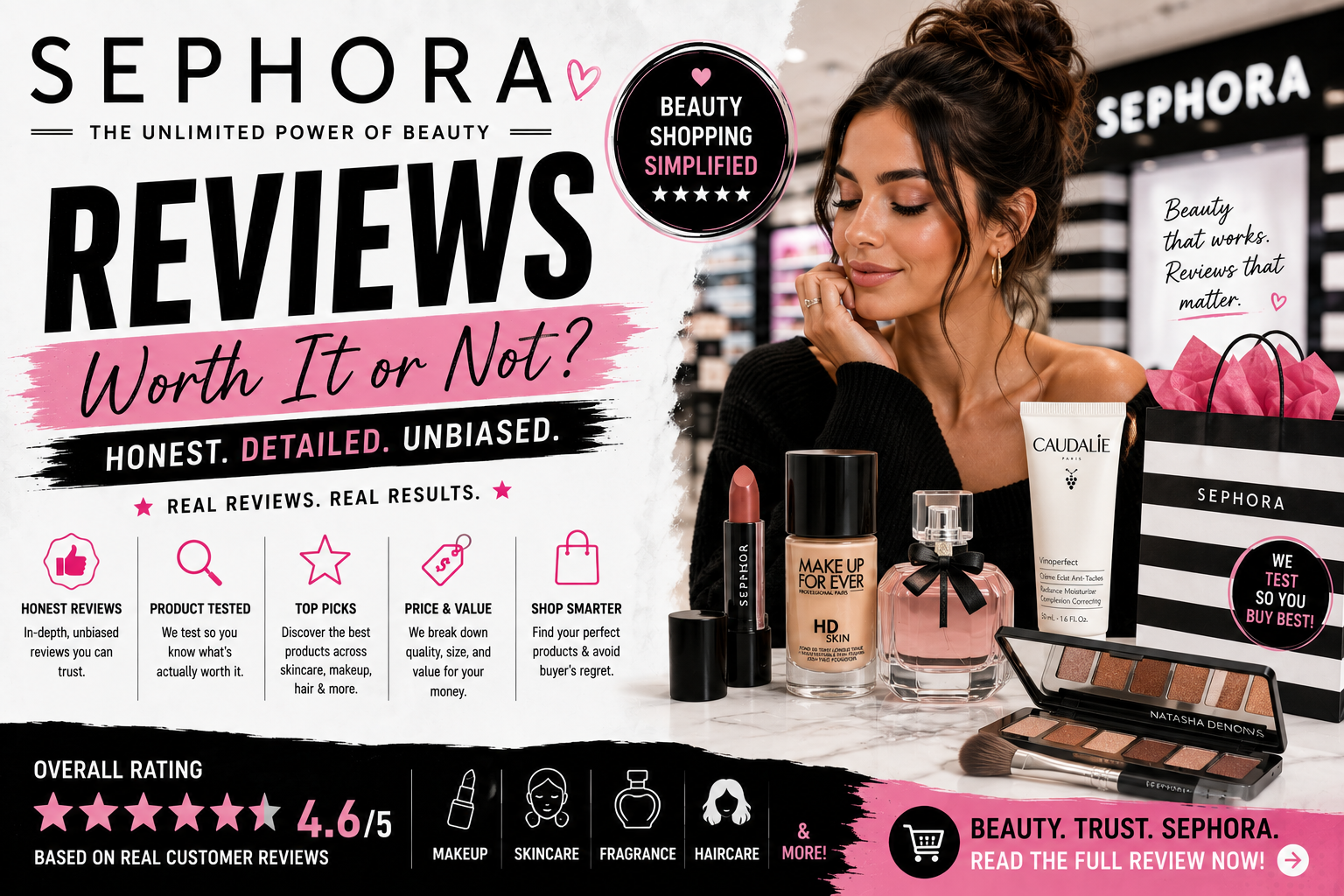
Sephora is a French multinational beauty retailer owned by luxury conglomerate LVMH, known for pioneering the “assisted self-service” model that lets shoppers test products freely before buying. This review covers Sephora’s history, product range, its widely used Beauty Insider loyalty program, pricing, and — importantly — a close look at its return policy and customer service, which show up as significant sources of frustration in independent reviews, especially since a notable policy change in 2025.
History of Sephora
Sephora was founded in Limoges, France, in 1970 by Dominique Mandonnaud, who had previously run a small chain of perfume shops called Shop 8. Mandonnaud’s genuinely disruptive idea was an “open-sell,” assisted self-service model — letting customers touch, smell, and sample products freely rather than shopping from behind a traditional department-store counter. He rebranded the concept as Sephora in 1993, combining the Greek word for beauty (“sephos”) with Zipporah (Séphora), the biblical wife of Moses, and merged it with his existing perfume chain.
Mandonnaud sold Sephora to LVMH (Moët Hennessy Louis Vuitton) in July 1997 for roughly 1.5 billion French francs (about $262 million at the time), in a deal personally championed by LVMH chairman Bernard Arnault. At acquisition, Sephora had 84 stores generating around $200 million annually; LVMH immediately funded aggressive international expansion, opening the brand’s first U.S. store in New York’s SoHo neighborhood in 1998. Today, Sephora operates roughly 3,000 stores across 35 countries, curates close to 500 beauty brands alongside its own private label (Sephora Collection), and its Beauty Insider loyalty program surpassed 45 million North American members in 2025 — with member transactions now accounting for roughly 80% of Sephora’s sales.
How Does Sephora Work?
Sephora sells through sephora.com, its mobile app, standalone stores, and Sephora-inside-JCPenney/Kohl’s shop-in-shop locations in the U.S. Its signature retail model still centers on open, testable displays organized by brand and category, often supplemented by in-store beauty services and consultations. The free Beauty Insider loyalty program underpins much of the shopping experience, offering points, birthday gifts, and tiered perks (Insider, VIB, Rouge) based on annual spend.
Sephora Product Categories
Sephora’s catalog spans nearly every beauty category, curated from close to 500 brands plus its own private label:
- Makeup: Prestige and emerging cosmetics brands, from foundations to the brand’s own bestselling Cream Lip Stain
- Skincare: A large, fast-growing category spanning drugstore-adjacent to ultra-prestige lines
- Fragrance: Both niche and mainstream perfume houses
- Haircare & tools: Styling tools, treatments, and haircare lines
- Sephora Collection: The brand’s affordable private-label line spanning makeup, tools, and basics
- Beauty services: In-store consultations, makeovers, and skincare services at many locations
Beauty Insider Loyalty Program
Sephora’s free Beauty Insider program is genuinely one of the most successful loyalty programs in retail, surpassing 45 million North American members in 2025 and generating around 80% of the company’s transactions. Members earn points on purchases, unlock tier-based perks (Insider, VIB, Rouge) as they spend more annually, and receive an annual birthday gift — a well-loved benefit that Sephora refreshes each year with rotating brand partners.
Sephora Product Quality & Selection
Since Sephora is primarily a curated multi-brand retailer rather than a manufacturer, “quality” here largely comes down to selection and in-store experience rather than a single product line. On that front, the brand’s core strength remains genuinely strong: an unmatched breadth of prestige and emerging beauty brands under one roof, tester availability for most products, and a well-regarded return policy for shade-matching issues specifically.
Where the experience has drawn more recent criticism is the in-store environment itself: independent reviews flag a “tester availability crisis” at some locations, with missing or unsanitary product samples undermining one of Sephora’s core value propositions — the ability to try before you buy. This appears to be a location- and staffing-dependent issue rather than universal, but it’s worth noting as a real, documented trend rather than an isolated complaint.
Sephora Pricing
Sephora operates as a prestige beauty retailer, so pricing reflects the individual brands it carries rather than a single Sephora price point — ranging from its own affordable Sephora Collection private label (often $10–$25) up through ultra-prestige skincare and fragrance lines that can run into the hundreds of dollars per item. Sephora Collection specifically offers a lower-cost entry point into the brand’s ecosystem without the premium pricing of the third-party brands it carries.
Sephora Shipping & Delivery
Beauty Insider members get free standard shipping on sephora.com, which is a genuinely strong perk given the program’s free enrollment. That said, independent reviews document real fulfillment issues: packages marked “delivered” that customers say they never received (with delivery photos reportedly not matching the customer’s actual address in at least one documented BBB complaint), samples being substituted with different products that then arrived damaged or evaporated due to shipping conditions, and orders shipped to incorrect addresses due to in-store data entry errors. If your order doesn’t arrive as expected, documenting the discrepancy (delivery photo, tracking, timestamps) immediately gives you the strongest case for a resolution.
Sephora Return & Refund Policy
Sephora’s current policy, effective for purchases made on and after April 24, 2025, allows a full refund to your original payment method for new or gently used products returned within 30 days of purchase, with proof of purchase required. This represents a meaningful tightening from Sephora’s historical policy, which many longtime customers remember as a more generous 60–90 day window that defaulted to store credit or exchange beyond 30 days.
This change is a genuine and frequently cited source of customer frustration. Reviews describe the new 30-day window as insufficient specifically for skincare, where a fair trial period often needs more time than a month, and multiple community forum posts describe confusion or disappointment upon learning that items outside the window now receive no refund, credit, or exchange at all in some cases — a stricter outcome than the previous system. Refund processing itself has also been cited as slow, with some reports of 6–8 week processing times, considerably longer than many comparable retailers.
A specific and separate issue involves in-store enforcement inconsistency: some customers without a Beauty Insider account report being told a return wasn’t possible at all, information that in at least one documented case turned out to be incorrect once escalated to corporate. Keeping your receipt, order confirmation, or Beauty Insider account details handy — and escalating past a single store associate if you get an answer that seems off — is a reasonable precaution based on this pattern.
Sephora Customer Service
Sephora offers support via phone, live chat, and its Beauty Insider community forum. Independent aggregators highlight a specific and serious pattern worth being aware of: multiple Better Business Bureau complaint pages are dedicated to Beauty Insider gift card fraud, following broader reporting (including an NBC investigation) into the issue. More routine complaints describe in-store staff being described as rude, dismissive, or condescending during return disputes, and the severity and volume of dissatisfaction has reportedly prompted some customers to discuss potential collective legal action on Sephora’s own community forums. Notably, the BBB gives Sephora an A+ business accreditation rating (reflecting responsiveness to complaints as a formal process) while customer-submitted reviews on the same platform average closer to 1.0 out of 5 — a genuinely striking gap between “a company that responds to complaints” and “a company whose responses satisfy customers.”
Sephora Reviews: What Do Customers Think?
Sephora presents a genuinely divided customer experience depending on who you ask. Independent review platforms show consistently low satisfaction scores, averaging around 2.3 to 2.6 out of 5 in the U.S., with notably worse scores reported in some international markets (as low as 1.6 out of 5 in Australia, per one aggregator) — suggesting real regional differences in operational execution. Return and refund processing issues account for a large share of negative reviews (one aggregator estimates 15–40%), and shipping/fulfillment problems and declining in-store tester availability are recurring secondary themes.
At the same time, Sephora maintains genuinely strong loyalty among its core, highly engaged Beauty Insider member base — the 80% of transactions coming from program members suggests a large group of satisfied repeat shoppers who value the selection, testers, and loyalty perks enough to keep returning despite the documented friction points. This divide — engaged loyalists versus newer or occasional shoppers hitting operational snags — is the clearest pattern across Sephora’s review landscape.
Is Sephora Legit?
Yes — Sephora is a genuine, long-established retailer owned by LVMH, the world’s largest luxury goods conglomerate, with roughly 3,000 stores across 35 countries and over five decades of operating history. Legitimacy is not in question. That said, the documented reports of Beauty Insider gift card fraud are worth being aware of specifically — protecting your account credentials and monitoring your gift card balance is a reasonable precaution given this documented issue, separate from the broader (and more common) service and return complaints.
Is Sephora Worth It?
If you’re a regular beauty shopper who values having dozens of prestige brands under one roof, testers to sample before buying, and a genuinely rewarding loyalty program, Sephora remains hard to match — this is exactly the profile of the highly engaged Beauty Insider members driving most of the company’s revenue. Joining Beauty Insider (it’s free) is worth doing regardless of purchase frequency, given the birthday gifts and points.
If you’re testing an expensive skincare product you’re unsure about, buy with the 30-day window specifically in mind — that’s a tighter runway than Sephora’s past policy, and less time than some competitors offer for a genuine trial period. If your order goes wrong (lost package, wrong item), be prepared to document everything and escalate past a single customer service contact if needed, given the review pattern described above.
Sephora Discounts & Promotions
Beauty Insider membership itself is the main discount vehicle — free enrollment unlocks points, tier-based perks, sales events (like the periodic “Beauty Insider Celebration”), and an annual birthday gift featuring rotating brand partners. Higher spending tiers (VIB and Rouge) unlock additional discount events and early access to sales throughout the year.
Where Can You Buy From Sephora?
Sephora sells through sephora.com, standalone retail stores, and Sephora shop-in-shop locations inside JCPenney and Kohl’s in the U.S. Given the documented tester-availability and in-store service inconsistencies at some locations, it may be worth checking recent reviews for your specific local store before an in-person visit if testing products is your priority.
Sephora Pros and Cons
Pros
- ✓ Unmatched breadth of prestige and emerging beauty brands
- ✓ Free Beauty Insider program with genuinely valuable perks and birthday gifts
- ✓ Free standard shipping for members
- ✓ Affordable Sephora Collection private label alongside prestige brands
- ✓ Strong loyalty among core, highly engaged customer base
Cons
- ✗ Return window tightened to 30 days as of April 2025, down from a more generous past policy
- ✗ Refund processing reported as slow (6–8 weeks in some cases)
- ✗ Documented Beauty Insider gift card fraud complaints
- ✗ Consistently low independent review scores despite BBB’s A+ accreditation
- ✗ Tester availability and in-store service quality vary noticeably by location
Best Alternatives to Sephora
| Retailer | Positioning | Best For |
|---|---|---|
| Sephora | Prestige multi-brand beauty | Broadest selection and loyalty perks |
| Ulta Beauty | Mass-to-prestige, salon services | Wider price range in one store, plus salon |
| Beautylish | Specialty, high-touch online retailer | Shoppers prioritizing service quality over selection size |
| Nordstrom Beauty | Department store, generous returns | Buyers who want an easier, longer return window |
| Brand direct sites | Single-brand, often better support | Buyers set on one specific brand |
FAQs About Sephora
Final Thoughts
Sephora’s core value proposition — an unmatched selection of prestige beauty brands, genuine try-before-you-buy access, and one of retail’s most rewarding loyalty programs — remains genuinely strong, and it’s exactly why tens of millions of Beauty Insider members keep coming back. But the 2025 return policy tightening, documented gift card fraud reports, and a real, measurable gap between formal complaint response and actual customer satisfaction are worth knowing before you buy, particularly for higher-priced or trial-dependent purchases like skincare.
Still the Best Selection — Just Watch the Return Window
Sephora’s brand selection and Beauty Insider program are genuinely hard to beat — just keep the tightened 30-day return window in mind, especially for skincare you’re still testing.